Saturday, 18 January 2014

Context that Changed Design - Entry #31


“The Development of Modernism ……”


The picture below shows a visual chart that I prepared regarding five designers (from five different art movements) who were all involved in the development of Modernism. 


Before creating this visual chart, I was imagining somebody reading a book about “Modernism” for the very first time – a book with just text.  So I wanted to create visuals to help the reader understand better the contents of the book.  The central bottom part of my chart reveals an open book showing text regarding Modernism and someone reading it.  I found this picture when I searched the internet.  Then, using pieces of white card, I made a small book.  I stitched the pages together in the middle, with the picture that I found on the internet at the top, and using double-sided tape I stuck the book to the chart.  This is a closer look to my little book:


The size of my chart is A2.  I used various websites to find images related to the 5 designers of my choice and their work.  Then I typed brief information regarding them/their styles.  I prepared five sheets of white card (approximately A4 in size) and I stuck the images and the information on them – one piece of card for every designer.  When I finished sticking them, I cut around the images so as not to leave any blank space of card around them.  Then I placed them on an A2 white card, and I stuck them on it clockwise, starting from William Morris (Arts & Crafts) and ending with Alvar Aalto (Organic Design).  I stuck them at different levels (using 2, 3, 4 and 5 layers of double-sided tape), like five steps going upwards, to show the development of Modernism.  I also prepared some arrows (out of white card), drew on them patterns that remind me of the particular movements/styles that the 5 designers were associated with, and then I stuck them in a way that also show the development of Modernism.  At the end, I used yellow acrylic paint to create borders around the images pertaining to the 5 different designers, to separate them slightly, and to make it easier for the viewer to see the difference between them.
 
The designers that I included on my chart are:


1.  William Morris (1834-1896)

 
  • He was the greatest proponent of the Arts & Crafts Movement (1850-1914);
  • He favoured craftsmanship;
  • Simplicity, practicality and the beauty in handmade products were very important to him;
  • Only wealthy people could afford the products, since they were individually made;
  • His reforming ideas during the Victorian era - utility, simplicity, suitability rather than luxury, producing objects of good quality, and using design as a democratic tool to change society - had an important impact on the early beginnings of the Modern Movement.
     
    ↑ The above image shows part of my chart that refers to William Morris and the British Arts & Crafts Movement
     
     
2.  Richard Riemerschmid (1868-1957) 

  • He was one of the founder of the Deutscher Werkbund (1907-1935);
  • His approach to design involved bringing harmony between the artistic efforts of the Arts & Crafts Movement and the industrial mass production of the Modern Movement;
  • He wanted high-quality products, yet he knew that industrial production was essential because it would lower the cost of products, making them affordable to many;
  • His designs for industrial production were distinguished by their realistic, yet elegant forms, and they were extremely influential.


↑ From William Morris to Richard Riemerschmid and the Deutscher Werkbund ↑


3.  Walter Gropius (1883-1969) 

  • When he was a member of the Deutscher Werkbund, he sided the members who favoured craftsmanship because he preferred the individualism and personal creativity in design, not mass production;
  • The steel and glass model factory that he designed for the “Deutsch Werkbund Ausstellung” in 1914  was a powerful demonstration of the Modern Movement;
  • After the First World War, he realised that industrial production was necessary;
  • He was the founder of Bauhaus (1919-1933) – promoted functionalism, industrial production techniques and state-of-the-art materials;
  • His modern designs were also revealed in the architectural work that he produced after he emigrated to Great Britain in 1934 and to the United States in 1937.


↑ From Richard Riemerschmid to Walter Gropius and the Bauhaus ↑


4.  Le Corbusier (1887-1965)
  •  He was one of the most influential designers/architects of the 20th century;
  • He had a new approach to modern design;
  • He had an affection for Classical Greek architecture;
  • He was attracted to the concept of the machine and wanted to transform the humble house into an industrialized product;
  • His concept of the house as “a machine for living” included tubular steel furniture such as the chairs that he designed in 1928, with two other designers - they were a perfect example of the International Style (1920-1980).


↑ From Walter Gropius to Le Corbusier and the International Style ↑


5.  Alver Aalto (1898-1976)

  • He was one of the founding fathers of the Organic Design (1930-1960);
  • Thanks to him and to other Scandinavian designers, Modernism did not lose its moral bearings in the 1930s, when International Style designers started going to extremes and were giving a bad reputation to the Modern Movement;
  • He initiated a humanizing form of Modernism;
  • He inspired a new generation of Modern Movement designers.


↑ From Le Corbusier to Alvar Aalto and the Organic Design ↑


Reference:     

Book: Fiell, C.F and P.F, (1999). Design of the 20th Century. 2nd ed. Germany: Taschen

Wednesday, 15 January 2014

Context that Changed Design - Entry #30


From all the designers that I mentioned in my previous writings, Peter Behrens and Raymond Loewy were the ones that mostly impressed me, so today I’m going to write more about their remarkable work :


Peter Behrens and Raymond Loewy


The German designer Peter Behrens (1868-1940) and the French-born American industrial designer Raymond Loewy (1893-1986) were two of the most influential designers of the 20th century. 


From 1890, after finishing his studies, Behrens became influenced by the Jugendstil Movement and during that time, working in Munich as a painter and graphic designer, the Jugendstil style was revealed in his colourful woodcuts, illustrations and book-bindings.  In the years that followed, Behrens became one of the members of the Munich Secession, set up the United Workshops with other designers, worked on the journal Pan, gave master classes in Nuremberg and was the director of Kunstwerbeschule. 


Behrens’ first furniture items were designed and displayed in 1898 and between 1899 and 1903, he designed his first building in Darmstadt – the Behrens House – a “complete-art-work”.  Even the furniture and its glassware were designed for it! 


Wikipedia, (2013), Peter Behrens’ House [ONLINE].


 [Accessed 15 January 14]


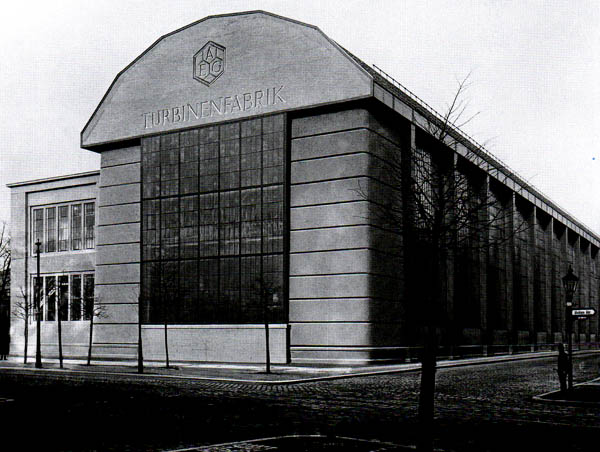
AEG was aware that “Industrial Art” was important because in 1907 it appointed Behrens as its artistic director.  It was the first time that a company employed a designer to give advice on all aspects of design.  Behrens designed the workers’ dwellings and factories, electrical products and created a corporate identity for AEG. 


J2X Arch Forum, (2013), Kiến trúc sư Peter Behrens [ONLINE].
 [Accessed 15 January 14]


          a world history of art, (2013), 1173. Peter Behrens (arch.), Karl Bernhard (eng.) [ONLINE].
[Accessed 15 January 14]


To make AEG’s production methods more efficient, Behrens included components which were identical in his various electrical products’ designs. 


File:Behrens-watch.jpg
Wikipedia, (2013), Industrial clock designed by Behrens for AEG in 1909 [ONLINE].
 [Accessed 15 January 14]


Quintessentia, (2010), Antique AEG German Electric Fan - circa 1908 [ONLINE]. Available at: http://www.quintessentia.com/media/catalog/product/cache/1/image/5e06319eda06f020e43594a9c230972d/a/n/antique_aeg_peter_
behrens_electric_table_fan_19245.jpg
[Accessed 15 January 14]


In October 1907, inspired by the British Arts and Crafts Movement, Behrens founded the Deutscher Werkbund with a few other well-known designers.  They were the pioneers of the Modern Movement and, realizing that standardization was necessary in order to industrially-manufacture high quality products as handcrafted ones, they adopted a sensible approach to design.  


11870.com, (2009), Deutscher Werkbund Yearbook 1913 [ONLINE].
 [Accessed 15 January 14]


That same year Behrens set up an office in Berlin and worked close to Walter Gropius (1907-1910), Ludwig Mies van der Rohe (1908-1911) and Le Corbusier (1910-1911) – three great designers associated with Bauhaus and the International Style. 


Wikipedia, (2013), Peter Behrens around 1913 in his office in Berlin [ONLINE].


Behrens spent the remaining years of his life working on numerous architecture and industrial design projects and designing several items for well-known businessmen.  His designs were simple, down-to-earth, sensible and extremely influential to Modernism’s development. 


Raymond Loewy’s output was abundant and he revolutionized the industry by creating all sorts of products – almost everything we see around us – from cigarette packets to refrigerators …… to cars and spacecrafts.  I consider him a genius. 


When Loewy was fifteen he won the famous James Gordon Bennett Cup, after he designed, built and flew a toy model aeroplane.  Consequently, he studied engineering and obtained his degree in 1918.  In 1919 he went to live in America.  After working as a window dresser and a fashion illustrator, in 1929 he set up his own industrial design office. 


The sleek protective cover that he designed for Sigmund Gestetner’s mimeograph machine using modelling clay (a technique that he used later on to design motor vehicles), and the “less box-like” shape of his car (unlike the existing motorcars) was sort of an introduction of what Loewy was going to be renowned for – the “streamlined” forms. 


Loewy’s design philosophy, “Most advance, yet acceptable”, made him very successful. 


In 1934 Loewy streamlined a refrigerator “Coldspot” for Sears.  This was the first household appliance that was sold for its looks, rather than its functionality. 


 Riell [project:Home] , (2013), RAYMOND LOEWY [ONLINE]. Available at: http://2.bp.blogspot.com/-FOJE16Rxiq4/UnjMVwaMhkI/AAAAAAAAdQw/iKBV5WZgkxI/s1600/0000799.jpg
[Accessed 15 January 14]


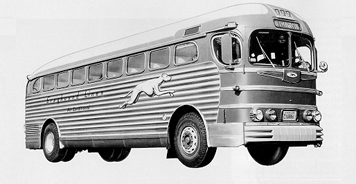
Between 1935 and 1947 Loewy was entrusted with several big projects, including the replanning of large department stores, designing aerodynamic locomotives, remodelling coaches for Greyhound and designing his “Champion” car (preceding his “Avanti”) for Studebaker.


admin , (2009), The Iconic greyhound bus: [ONLINE].


admin , (2009), The Iconic greyhound bus: [ONLINE].


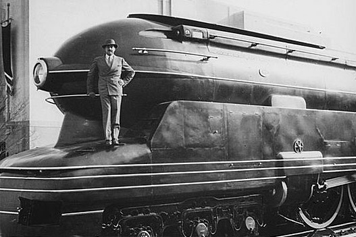
admin , (2009), In 1937 Loewy began working with the Pennsylvania Railroad, his most famous designs being their passenger locomotives. Loewy is shown below with the S1 locomotive. The S1 is an essential piece of mid-century Americana, and the perfect example of the “streamlining” design style, of which Loewy was a principal pioneer. The swept front of the train was known as the “shark nose”. [ONLINE]. Available at: http://www.crowbarstudios.com/blog/wp-content/uploads/2009/03/raymond-loewy-and-train-crowbar-studios.jpg [Accessed 15 January 14]


admin , (2009), The Studebaker Champion [ONLINE].

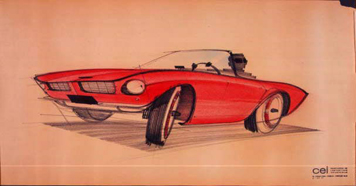
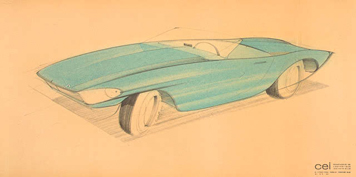
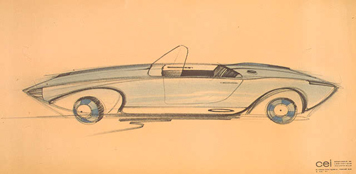
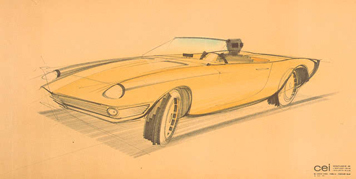
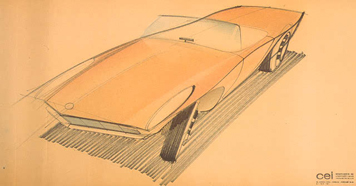
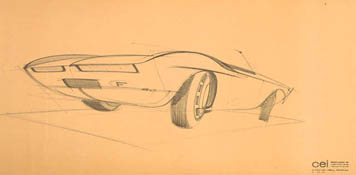
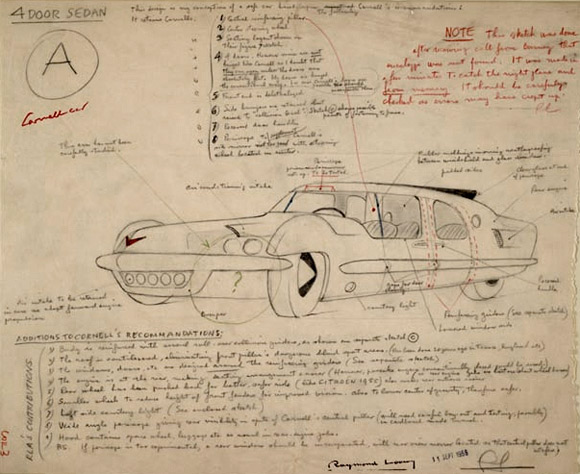
admin , (2009), From 1936 on, Loewy and associates worked with Studebaker Motors, eventually designing the 1963 Avanti, the original streamlined sketches for the Avanti are shown below. This Car was introduced in a time when people began concerning themselves with gas prices, with a small, light sports feel, the Avanti had amazing gas milage for it’s time. A used one these days, in good condition, would cost you about $15,000. [ONLINE]. Available at: http://www.crowbarstudios.com/blog/wp-content/uploads/2009/03/raymond-loewy-avanti-sketch-8-crowbar-studios.jpg [Accessed 15 January 14]


[image]
MordEth, (2008), Courtesy Library of Congress [ONLINE].
 [Accessed 15 January 14]


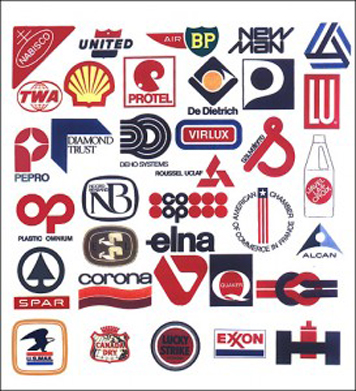
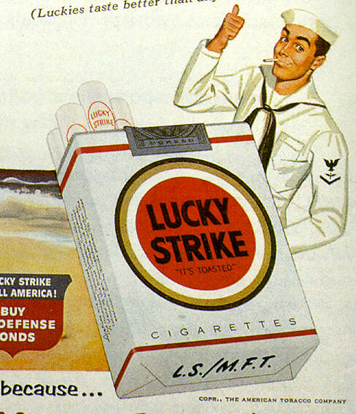
Loewy was also famous for his corporate identity work, including the logos for Shell and BP and the repackaging of Lucky Strike Cigarettes. 


admin , (2009), Logos by Loewy Associates: [ONLINE].


admin , (2009), Logos by Loewy Associates: [ONLINE].


[Accessed 15 January 14]

White Motor Truck at WOCC
 [Accessed 15 January 14]


Raymond Loewy - Loewy Coca-Cola Designs
pinterest, (2012), Raymond Loewy - Loewy Coca-Cola Designs [ONLINE].
 [Accessed 15 January 14]


In the years that followed, together with his associates, he was engaged in several architectural projects and during the 1960s and 1970s he was a consultant to the American Government. 


Air Force One for John F Kennedy
    Loewy was in charge of its re-designing

SuperRadNow, (2012), Air Force One [ONLINE].


[Accessed 15 January 14]


Nasa Skylab (1969-1970)


Loewy was in charge of re-designing its interiors


Travisimo, (2011), Skylab concept... [ONLINE].


 [Accessed 15 January 14]


The works of Peter Behrens, who was one of the pioneers of the Modern Movement, and Raymond Loewy, who was the greatest pioneer of Streamlining, brought about changes in attitude towards design and culture and great changes to society. 


  Other References:


admin . 2009. Design Icon: Raymond Loewy. [ONLINE]


[Accessed 15 January 14]


Book: Fiell, C.F and P.F, 1999. Design of the 20th Century. 2nd ed. Germany: Taschen